

EMDR For Anxiety
Dec 12th 2025
Anxiety isn't one single experience. It's a spectrum of physical tension, racing thoughts, anticipatory fear, and internal alarm signals that can surface even when nothing objectively dangerous is happening. It can show up during stressful moments, in social interactions, or out of nowhere while you’re sitting on the couch.
Eye Movement Desensitization and Reprocessing (EMDR) is one therapeutic approach some clinicians use to help people work with anxiety responses. Originally developed for trauma, EMDR has expanded as practitioners and researchers began noticing its potential role in addressing patterns of worry, panic, fear, and persistent stress reactions.
This guide explains what EMDR for anxiety refers to, how clinicians conceptualize the process, what you can expect, and what current research actually supports — without making medical claims or promising outcomes. This is an informational resource, not a diagnosis or treatment recommendation.
What “Anxiety” Actually Refers To in a Clinical Context
People often use the word “anxiety” to describe anything from mild nerves to debilitating fear. Clinically, anxiety refers to a blend of cognitive, physical, emotional, and behavioral responses driven by the brain’s threat-detection systems.
Common Patterns Across Anxiety Disorders
Across different anxiety conditions, certain themes appear repeatedly:
- A tendency to overestimate threat
- A tendency to underestimate one’s ability to cope
- Rapid physiological arousal (heart rate, breathing, tension)
- Mental “loops” that return to fear-based thoughts
- Avoidance of situations that trigger distress
These patterns can show up in generalized anxiety disorder (GAD), panic disorder, social anxiety, health anxiety, phobias, and similar conditions.
Physical vs. Cognitive vs. Situational Anxiety
- Physical: rapid heart rate, dizziness, sweating, muscle tension
- Cognitive: “What if I can’t handle this?” “What if something bad happens?”
- Situational: anxiety tied to places, people, memories, sensations, or future possibilities
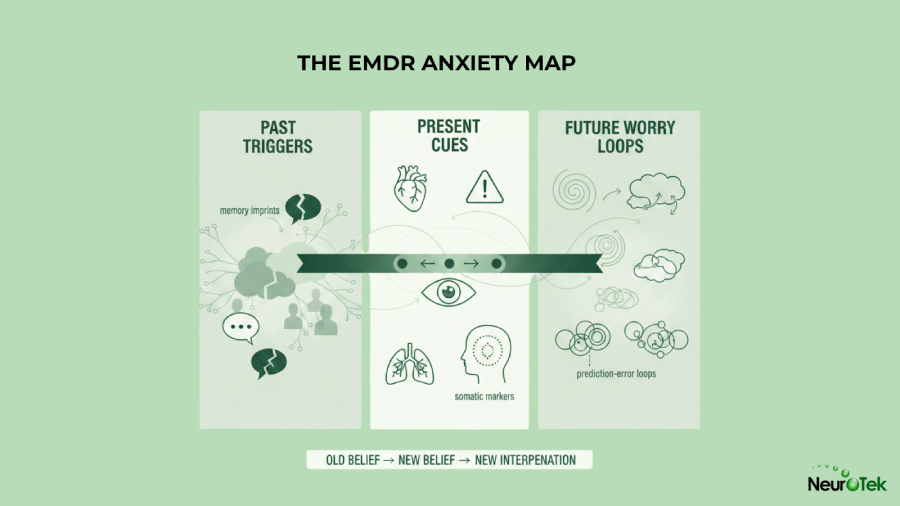
Past Events, Present Triggers, and Future Simulations
Anxiety isn’t only about what is happening - it’s often about:
- Past experiences that shaped fear responses
- Current stimuli that trigger old patterns
- Future-oriented simulations (“What if this happens again?”)
When Anxiety Appears Without Obvious Cause
Sometimes anxiety surfaces “out of nowhere.” In reality, internal cues such as sensations, subtle associations, or learned responses may be firing beneath conscious awareness - something EMDR practitioners sometimes explore.
How EMDR Conceptualizes Anxiety (AIP Model Explained Simply)
EMDR is based on the Adaptive Information Processing (AIP) model, developed by Dr. Francine Shapiro.
The Core Idea: Unprocessed Experiences Can Influence Present Responses
The AIP model proposes that:
- Some experiences remain “stuck” in the nervous system
- These unprocessed memories can influence how a person responds now
- Present triggers may activate old patterns, even if someone isn’t consciously aware of the connection
Why This Applies Beyond Trauma
Although EMDR began as a trauma therapy, clinicians sometimes apply AIP principles to:
- worry loops
- fear-based predictions
- learned fear responses
- chronic anticipatory tension
How Practitioners Map “Targets” Related to Anxiety
A “target” isn’t always a major traumatic event. It could be:
- moments of embarrassment
- early experiences of anxiety
- panic episodes
- family interactions tied to fear
- body sensations
- imagined future scenarios
Important Note
EMDR is not a cure, not a guarantee, and not a replacement for medical evaluation. It is one therapeutic lens some professionals use to explore how anxiety patterns form and how they can shift.
Core Components of EMDR for Anxiety
The Role of Bilateral Stimulation (BLS)
BLS involves alternating left-right stimulation through:
- eye movements
- tactile tapping
- auditory tones
Practitioners use BLS while clients focus on memories, sensations, or beliefs to support new connections and insights.
Bilateral Stimulation Options
- Eye movements (traditional method)
- Tactile pulses
- Audio tones
This is an ideal place for an internal link to NeuroTek’s EMDR devices to show how bilateral stimulation tools support the therapeutic process.
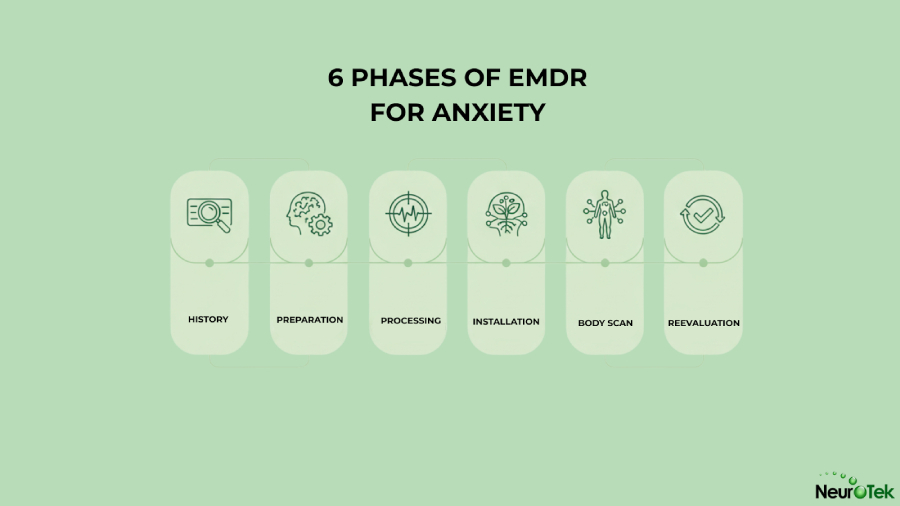
The Eight-Phase Framework, Simplified
The EMDR protocol includes:
- History
- Preparation
- Assessment
- Desensitization
- Installation
- Body Scan
- Closure
- Reevaluation
Anxiety-oriented work typically adapts the protocol to target worry patterns, fears, or memories tied to anxiety triggers.
Readiness and Pacing
Clinicians evaluate:
- emotional stability
- coping tools
- ability to stay grounded during reprocessing
No one moves into reprocessing until stabilization is secure.
EMDR for Different Types of Anxiety Disorders
This section is informational — not medical advice and not a treatment claim.
EMDR for Generalized Anxiety Disorder (GAD)
GAD often involves:
- chronic worry
- difficulty controlling fear-based predictions
- tension that persists even without triggers
Practitioners may explore:
- early learning experiences with fear
- past moments where worry escalated
- patterns of anticipating worst-case scenarios
EMDR for Panic Disorder / Panic Attacks
Panic can feel sudden, overwhelming, and unpredictable. Clinicians sometimes explore:
- the first, worst, or most recent panic episodes
- the fear of the sensations themselves
- beliefs like “I’m losing control” or “I’m in danger”
Again, this is a conceptual explanation — not a treatment claim.
EMDR for Social Anxiety
Social anxiety can be anchored in:
- past embarrassment
- moments of criticism
- situations involving judgment
- ongoing hypervigilance around others’ perception
Practitioners may work with:
- memory networks tied to social fear
- future-oriented anxiety about interactions
- performance anxiety patterns
EMDR for Specific Phobias
Phobias involve intense, cue-specific fear. EMDR may explore:
- earlier fear-learning moments
- current triggers
- mental simulations of feared situations
EMDR for Health Anxiety
Health anxiety involves:
- misinterpretation of normal bodily sensations
- future-focused worry about illness
- hyperattention to internal cues
EMDR practitioners sometimes explore:
- earlier experiences of medical fear
- anxiety tied to illness in family members
- past episodes where sensations were interpreted as dangerous
Again, EMDR does not diagnose medical conditions.
EMDR for Anxiety That Isn’t Trauma-Related
Not all anxiety stems from “big T” trauma. EMDR may work with:
- cumulative stress
- repeated criticism
- performance pressure
- chronic uncertainty
- imagined future threats
Sometimes the focus is not on past events but on internal cues such as:
- sensations
- thoughts
- worry imagery
What an EMDR Session for Anxiety May Explore
While avoiding operational details:
- recurring thoughts or beliefs
- physical sensations
- emotional patterns connected to anxiety
- triggers that activate worry or panic
- ways responses shift over time
Communication with the practitioner is essential throughout.
What Current Research Says (Without Claims)
Research has examined EMDR’s role in:
- panic disorder
- phobias
- certain aspects of generalized anxiety
- stress-related symptoms
Examples of well-known findings:
- Studies show EMDR can reduce symptoms of PTSD, panic, worry, and fear for some individuals.
- Several small trials suggest EMDR may perform comparably to CBT in certain anxiety presentations.
- Systematic reviews highlight promising results, but emphasize the need for larger controlled trials, especially for social anxiety and health anxiety.
No research suggests EMDR is universally effective, and more studies are needed.
EMDR Is Not the Only Approach
Anxiety is multifaceted. Other evidence-based approaches include:
- Cognitive Behavioral Therapy (CBT)
- Exposure-based approaches
- Mindfulness-based strategies
- Somatic approaches
- Lifestyle changes (sleep, stress load, nutrition, etc.)
EMDR is one tool — not the entire toolkit.
Frequently Asked Questions For EMDR For Anxiety
Is EMDR only for trauma?
No — practitioners sometimes apply it to various anxiety patterns.
Can EMDR be used if anxiety feels “random”?
Practitioners may explore internal cues, subtle experiences, or anticipatory imagery.
How does bilateral stimulation relate to anxiety?
It supports reprocessing by engaging both hemispheres and helping clients stay grounded.
How long do EMDR sessions last?
Typically 60–90 minutes, depending on the clinician.
Does EMDR feel emotionally intense?
It can involve strong emotions, which is why preparation is essential.
Can EMDR be combined with other therapies?
Often, yes. Many clinicians integrate EMDR with CBT, mindfulness, or somatic work.
Do EMDR devices work the same as therapist-led stimulation?
Devices provide bilateral stimulation, which clinicians may use as part of EMDR protocols.
Conclusion
EMDR for anxiety is a developing, evidence-informed approach grounded in the idea that present fear responses can be shaped by unprocessed past experiences, learned patterns, or internal cues. While not a cure-all or medical treatment, EMDR provides a structured way for clinicians to explore how anxiety formed — and how responses can shift over time.
Anxiety is complex, and no single method addresses every aspect of it. If you’re exploring EMDR or any therapeutic option, speaking with a qualified mental health professional is the most responsible next step.
If you found this guide useful, share it or explore our related resources on EMDR tools and bilateral stimulation.
Sources:
[1] National Institute of Mental Health — Anxiety Disorders
https://www.nimh.nih.gov/health/topics/anxiety-disorders
[2] World Health Organization — Guidelines for the Management of Conditions Specifically Related to Stress
https://www.who.int/publications/i/item/WHO-MSD-MER-17.5
[3] American Psychological Association — Clinical Practice Guideline for the Treatment of PTSD
https://www.apa.org/ptsd-guideline/treatments/eye-movement-reprocessing
[4] Feske, U., & Goldstein, A. J. (1997).
Eye Movement Desensitization and Reprocessing Treatment for Panic Disorder: A Controlled Outcome Study.
Journal of Consulting and Clinical Psychology, 65(6), 1026–1035.
https://pubmed.ncbi.nlm.nih.gov/9420364/
[5] de Jongh, A., et al. (2019).
EMDR Therapy for Anxiety Disorders: A Meta-Analysis.
Journal of Anxiety Disorders, 64, 28–40.
https://pubmed.ncbi.nlm.nih.gov/31039461/